
India is among the three least-favoured Asian stock markets, according to BofA Securities whose survey found that 10 per cent of fund managers are underweight on Indian equities from a 12-month perspective.

After declining to a three-year low in FY24, the private sector investment is expected to fall further in the current financial year, India Ratings said in a research note.. The investments in the private sector are likely to plummet to below 11 per cent of the GDP in FY25, based on the trends from the latest national accounts data and company fillings, it noted.
'Deposit and lending rates have started to fall considerably. It is likely to spur investment and consumption of durables.'
Air India sale will give a boost to India's privatisation drive, the Economic Survey said on Monday, as it suggested redefining the public sector role in business enterprises to encourage private participation in all sectors. The government earlier this month handed over ownership rights in national carrier Air India to Tata Group for Rs 18,000 crore. The amount includes the takeover of the debt burden of Rs 15,300 crore and another Rs 2,700 crore in cash.
The Reserve Bank of India (RBI) has projected retail inflation at 4.2 percent for the next financial year beginning April while retaining the forecast for 2024-25 at 4.8 percent. The central bank attributed the expected easing of inflation to good kharif production, winter-easing in vegetable prices and favorable rabi crop prospects. However, the RBI also noted that continued uncertainty in global financial markets coupled with volatility in energy prices and adverse weather events presents upside risks to the inflation trajectory.

India's Gross Domestic Product (GDP) is expected to expand by 9.2 per cent in the current financial year, according to the Economic Survey 2021-22 tabled in the parliament on Monday. "Advance estimates suggest that the Indian economy is expected to witness real GDP expansion of 9.2 per cent in 2021-22 after contracting in 2020-21. "This implies that overall economic activity has recovered past the pre-pandemic levels," Economic Survey noted. Almost all indicators show that the economic impact of the "second wave" in Q1 was much smaller than that experienced during the full lockdown phase in 2020-21 even though the health impact was more severe, it said.
As the poverty rates in the country declined below 5 percent in 2024, a research study by State Bank of India also highlighted that the extreme poverty in the country has been reduced to minimal.

Adarsh Rai, an emotional intelligence coach and the founder-CEO of HR Brain HUB, suggests simple, practical tips that will help you adapt and thrive while working with Gen Z and millennial bosses in today's evolving workplace.

Jaishankar described as a "reasonable supposition" to expect some improvement in the relations between India and China following the last round of disengagement but hesitated to say that there could be a reset of the ties.
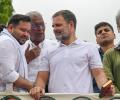
'The long term strategy is that this government wants to create a second class citizen list.'

Following are the highlights of the Economic Survey 2022-23 tabled in Parliament on Tuesday
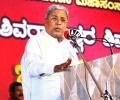
Opposition to the Karnataka government's proposed implementation of a caste census has intensified with dominant communities raising concerns about the survey's findings. The report, which has not been publicly released, is said to contradict traditional perceptions regarding the numerical strength of various castes, particularly Veerashaiva-Lingayats and Vokkaligas. These communities, along with political parties, including sections of the ruling Congress, have criticized the survey as "unscientific" and demanded a fresh assessment. The Vokkaligara Sangha and the All India Veerashaiva Mahasabha have expressed strong opposition, alleging that the report misrepresents their populations and demanding a fresh survey. Meanwhile, Dalit and OBC groups have defended the survey and its recommendations, including an increase in reservation for OBCs to 51%. The controversy has fueled political tensions in Karnataka, with opposition parties accusing the Congress government of using the caste census for political gain.

The Indian government's announcement of 10,000 additional seats in medical colleges next year, part of a plan to add 75,000 seats over five years, has been welcomed by education experts and stakeholders. The move aims to address the shortage of medical professionals and reduce the outflow of Indian medical students to other countries. The budget also includes infrastructure expansion at five new IITs to accommodate 6,500 more students and an allocation of Rs 500 crore to set up a Centre of Excellence in Artificial Intelligence for education.

'This is going to generate a new debate on reservation because the quota for Economically Weaker Sections is 10%, and that is for nearly 16% of the population.' 'For 16% you are giving 10%. This is set to raise eyebrows among the OBCs after the caste survey.'

Data 'of the people, by the people, for the people' must become govt's mantra, says Survey.

One could argue that India is not troubled in the same way as China is by a declining population and structural problems in real estate/construction and finance. But India has serious trade and fiscal imbalances, and excessive dependence on capital expenditure by the government, points out T N Ninan.

Ahead of the assembly polls in Rajasthan, the Congress government on Saturday night issued an order for the conduct of a caste survey in the state.

This will be the first full-year Budget of the BJP-led National Democratic Alliance government since it came to power for a third consecutive term in July last year.

According to the survey report, the government's move to earmark Rs 76,000 crore outlay for semiconductors and display manufacturing segment will aid their production in the country. The survey said that government intervention to boost semiconductors and display manufacturing ecosystem in the country has come at a time when the global economy is facing acute shortage of semiconductors due to severe disruptions in supply chains.

The pre-Budget Survey said for wealth to be distributed, it first has to be created and called for looking at wealth creators with respect. The Survey said government interventions seem to be ineffective in stabilising prices of commodities such as onions.

Adarsh Kumar, the son of a farmer and a Class 12 student from rural Bihar, is on a mission to build one of India's largest free skill development movements, powered only with a laptop, free Internet and his relentless determination.
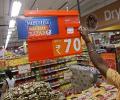
As per the survey, the trade sector that comprises wholesale and retail grew by 4.8 per cent to Rs 14.79 lakh crore (Rs 14.79 trillion) in 2012-13, accounted for 15.8 per cent share in the gross domestic product.
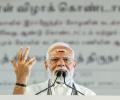
The message from Sunday's event will undoubtedly reverberate globally. It's a landmark occasion that will be remembered for generations and will inspire many other states to introduce the story of Rajendra Chola into school curricula, says Tarun Vijay.

The most striking features of this Budget was its focus on simplification and improving the ease of doing business in India, asserts Kaku Nakhate.
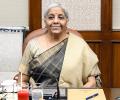
While the capital spending is being maintained at 3.1 per cent of the GDP, a little more would have boosted economic growth even further, suggests Rajiv Memani.

An increase in government spending on the healthcare sector - from the current 1 per cent to 2.5-3 per cent of GDP - as envisaged in the National Health Policy 2017 could reduce out-of-pocket expenditures, as per the Economic Survey 2020-21. The rise in public spending can lead to a reduction in expenditures from 65 per cent to 30 per cent of overall healthcare spend, it noted. The Economic Survey said that for the country to effectively respond to future pandemics, the country's health infrastructure needs to be agile. Given its potential to provide healthcare access in remote areas, telemedicine needs to be harnessed to the fullest by especially investing in internet connectivity and health infrastructure, it added.

'The fiscal deficit target of 3.9 per cent of GDP seems achievable.'

Could the MPCE survey results be used as a basis of reconstructing the Consumer Price Index with new weights, asks Madan Sabnavis.

'Mamata needs to address the anger and resentment among various sections of the Hindu community because low-scale communal violence has always paid richer electoral dividends for the BJP.'

Monetary Policy- Easing expected to happen later this financial year.
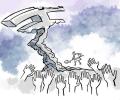
India's primary deficit (Centre and states) for FY21 is assumed to be 6.8 per cent of GDP, according to the Economic Survey tabled in Parliament on Friday. It said the Covid-19 pandemic has created a significant negative shock to demand. Active fiscal policy -- one that recognises that fiscal multipliers are disproportionately higher during economic crises than during economic booms -- can ensure that the full benefit of seminal economic reforms is reaped by limiting potential damage to productive capacity.
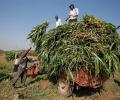
The World Bank on Tuesday raised the growth forecast for the Indian economy to 7 per cent for the current fiscal year on the back of recovery in agri sector and rural demand. World Bank had in June projected India to grow at 6.6 per cent for FY24. According to the World Bank Report released on Tuesday, India's growth continues to be strong despite a challenging global environment.
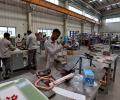
India's manufacturing sector growth fell to a joint 11-month low of 56.5 in November, restricted by competitive conditions and inflationary pressures amid a softer increase in factory orders, a monthly survey said on Monday. The seasonally adjusted HSBC India Manufacturing Purchasing Managers' Index (PMI) fell from 57.5 in October to 56.5 in November, signalling a softer improvement in the health of the sector. However, the pace of growth remained above its long-run average.

The government today extended the tenure of Chief Economic Adviser Arvind Virmani by three months on a temporary basis, said a finance ministry spokesperson. His current two-year term came to an end on Tuesday.
The government should cut customs duties and streamline export promotion schemes and pay special attention to infrastructure to overcome the contracting exports on account of recession in India's major trading partners, the Economic Survey said.

India ranks lower than most BRICS nations in terms of innovation.
The 2005-06 Survey tabled in Parliament said the Indian industry needed to be unburdened from high level of taxes and distortive exemptions that provided perverse incentives.

Geopolitical tensions, trade policy uncertainties, volatility in international commodity prices and financial market uncertainties pose considerable risks to India's economic growth in the coming year, the finance ministry cautioned on Wednesday. "Global trade continues to be affected by uncertainty in the policy environment... tariff-related developments in multiple countries have heightened trade-related risks, affecting investment and trade flows globally.

Inflation has reappeared as a global issue in both advanced and emerging economies and India needs to be wary of "imported inflation", especially due to high oil prices, according to the Economic Survey 2021-22 released on Monday. "Inflation has reappeared as a global issue in both advanced and emerging economies. "India's Consumer Price Index inflation stood at 5.6 per cent YoY in December 2021 which is within the targeted tolerance band," the survey report presented in the Parliament by Finance Minister Nirmala Sitharaman noted.

62 per cent of respondents across various demographics, including villages, towns, and cities, perceived a greater difficulty in securing employment compared to the previous five years, shows pre-poll survey by Centre for Study of Developing Societies.
 © 2026 Rediff.com - Advertise with us - Disclaimer - Privacy Policy - Sitemap - Feedback - About us - Terms of use - Grievances